What YouTube Comments Reveal About Diastasis Recti Recovery
This article presents data analysis of publicly available YouTube comments. It is not medical advice. Always consult a qualified healthcare professional before making decisions about your health or starting any exercise programme.
Crunches. Sit-ups. Full planks.
Every top-rated diastasis recti video on YouTube rejects them by name.
That's unusual. Most exercise videos tell you what to do. The top diastasis recti content opens with what to stop — and the commenters who close their separation keep thanking the creators for leading there.
The rule runs through every top-five routine. The data behind it tells a more specific story than "just don't do crunches."
The numbers, honestly
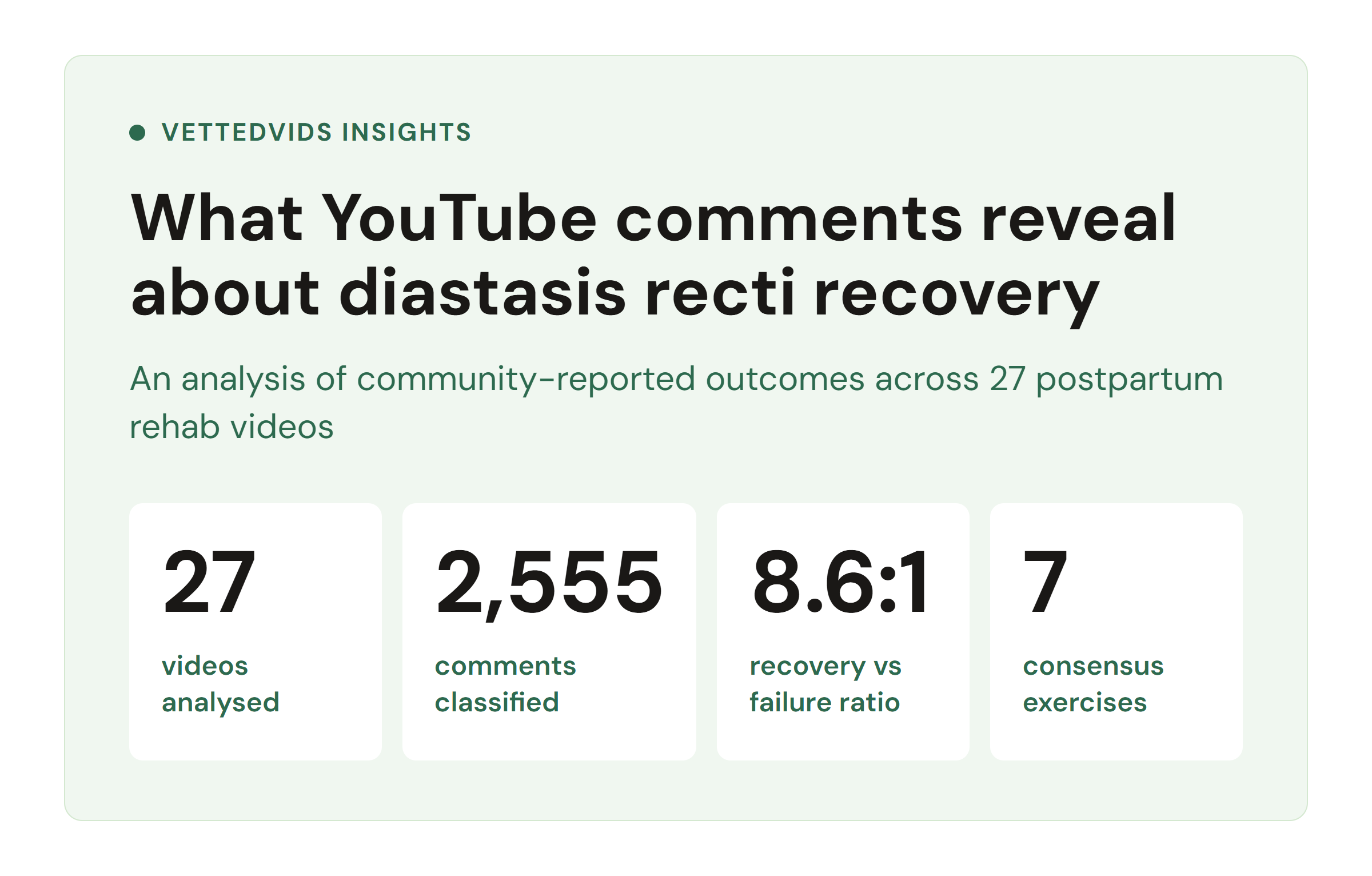
Across the five highest-rated diastasis recti videos on YouTube — four Personal Trainers and one Registered Dietitian, with 500 top comments — automated analysis identified 52 time-delayed recovery reports. These are people returning days, weeks, or months later to describe finger-gap changes, regained core control, or daily movements that used to hurt and no longer do.
Against those 52 reports, there were 5 people who said the exercises didn't help. Widen the view to 2,555 comments across the full 27-video discovery pool and the ratio holds at 8.6 to 1.
The same caveat as always — stronger here. YouTube comments carry a heavy survivorship bias. People who improve are far more likely to return and comment. And on manual review, several of the "failure" matches turned out to be success stories referencing earlier failure — I tried everything, nothing worked, until this. The number of genuinely unresolved failure reports across the whole pool is in the low single digits.
Scale matters too. The diastasis recti ratio sits an order of magnitude below back pain (338 to 1) and sciatica (120 to 1) — not because the exercises work less, but because the separation takes longer to close and is more sensitive to form. The people who succeed commit to months, not weeks.
The 7-exercise consensus
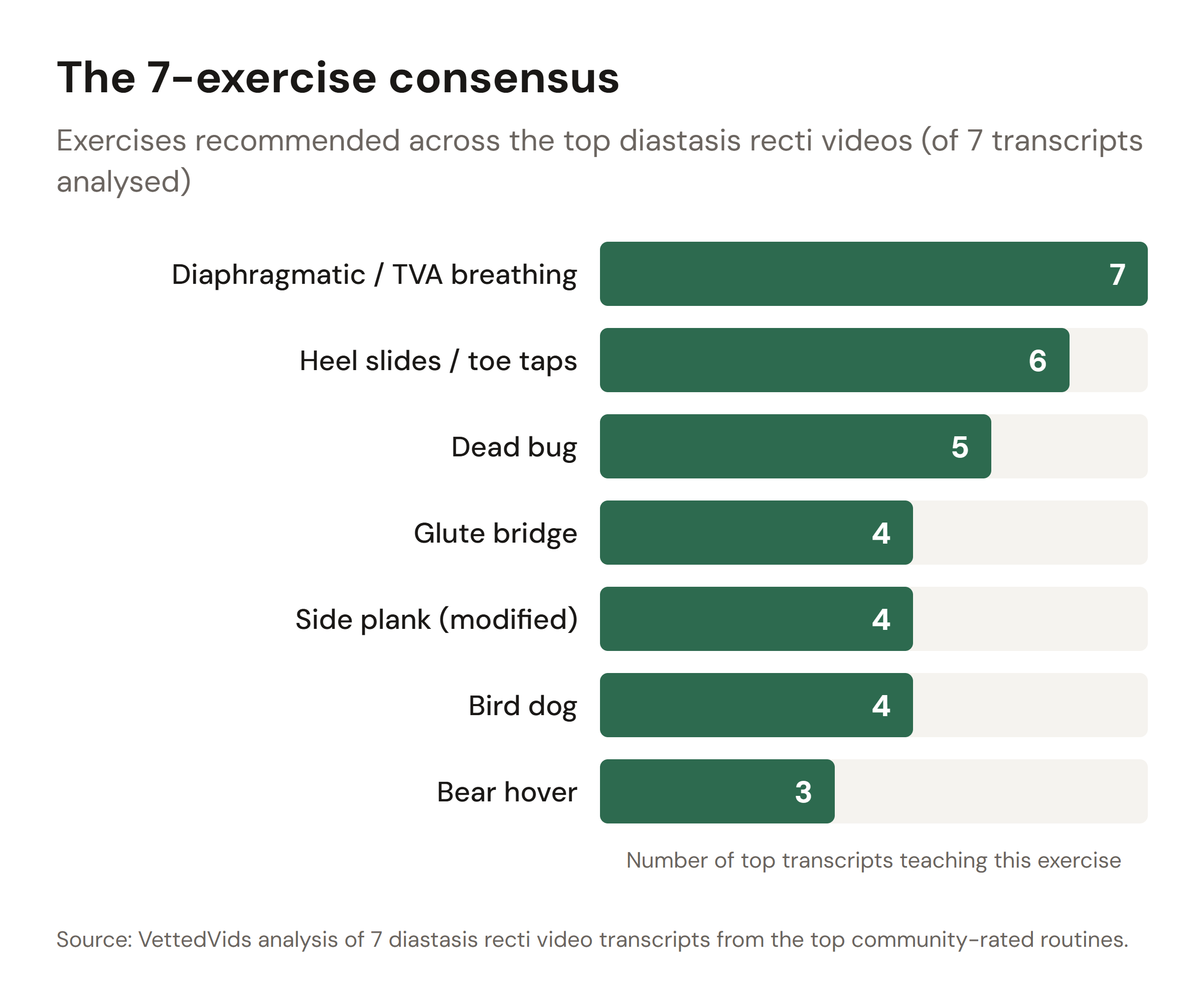
Seven top diastasis recti videos were analysed for exercise overlap. Seven exercises appeared in three or more of them.
Diaphragmatic, or transverse abdominis, breathing appears in all seven. Every routine opens with it. The cue is the same across creators — inhale to expand the ribs, exhale while drawing the belly button toward the spine. Zipping tight jeans. A corset tightening. Commenters describe this single movement, practised before any other exercise, as where they first felt their core engage again.
Heel slides and toe taps from a bent-knee position appear in six of seven. A slow alternating leg movement that teaches the deep core to hold while the extremities move. Creators stop the slide before the knee tracks past the hip, to keep the core pressure on.
Dead bug appears in five of seven. From a tabletop position, slowly lower an opposite arm and leg without letting the lower back arch off the mat. It's the movement most commonly cited in comments as the one that finally felt like real core work.
Glute bridge, bird dog, side plank (modified on the bottom knee), and bear hover each appear in three or four of seven. The bridges build the posterior chain. Bird dog works anti-rotation from tabletop. Side plank is the universally offered substitute for the full plank. Bear hover — knees hovering an inch off the mat from tabletop — appears in the advanced segments.
Agreement on form is high. Every creator teaches the same three cues: press the lower back into the mat, engage on the exhale, stop before the midline bulges. No video contradicts another on execution.
What to avoid
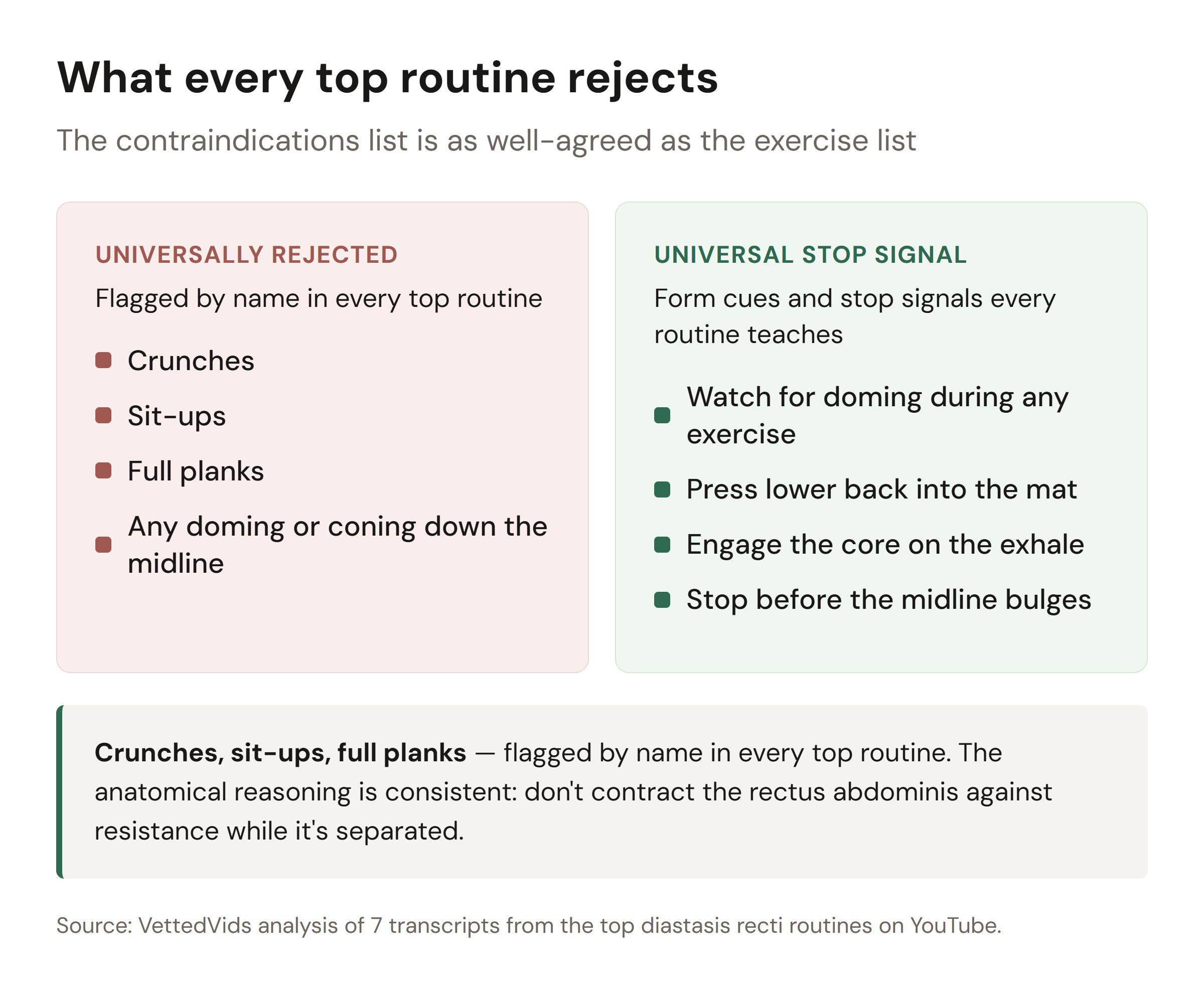
This is where diastasis recti content is unusually well-agreed.
Crunches, sit-ups, and full planks are flagged by name in every video that addresses contraindications. The reasoning, when creators explain it, is anatomical. The rectus abdominis is the muscle that's been separated; crunches and sit-ups actively contract it against resistance, and a full plank loads the weight of the organs down onto stretched connective tissue. Both work directly against the gap closing.
Doming, coning, or bulging down the midline is the universal stop-signal. Every top video teaches the same self-check: notice the shape of your stomach during the movement. If a line of tissue tents up between the hips and the sternum, the exercise is too much. Pull back to a modified version.
One video in the top five — growwithjo's thirty-minute routine — includes hollow body holds in its advanced round. Hollow body holds are exactly the kind of rectus-dominant move the rest of the pool warns against. It's the only top-five video that does this, and it's also the one that scored lowest.
Side plank is where the creators split. Most treat it as the safer plank substitute. Lauren Fitter treats it as an advanced progression. A commenter at 11 months postpartum describes massive doming during side plank. The implicit rule: side plank is usually safer than full plank, but safer is not the same as universally safe. The doming check applies to every movement, including the ones the creators recommend.
Why the top of the list looks unusual
Two videos in the top five come from the same creator — Fit With Sally. That's unusual; each top-five slot normally belongs to a different creator.
It isn't a reach story either. Her videos have the lowest view counts of the top five — 936,000 and 1.88 million. The others sit between 1.97 million and 4.4 million, and several higher-reach videos from the wider pool didn't make the top five.
What her videos share is structure. Both are 12 to 13 minutes — short enough to complete during a nap window, long enough to feel like a workout. Both open with the anatomy rule in the first ninety seconds: the goal is to train the transverse abdominis, and that means no crunches, no sit-ups, no planks. Both show a regular and an advanced version of each exercise with an explicit rule for when to progress.
The most-repeated pattern in her comments is some variation of I tried everything else first, this was simpler, and I stuck with it.
Two of her videos in the top five isn't "Sally dominates diastasis recti YouTube." It's two of her videos meeting the same bar — and the bar is hard to clear.
When people get better
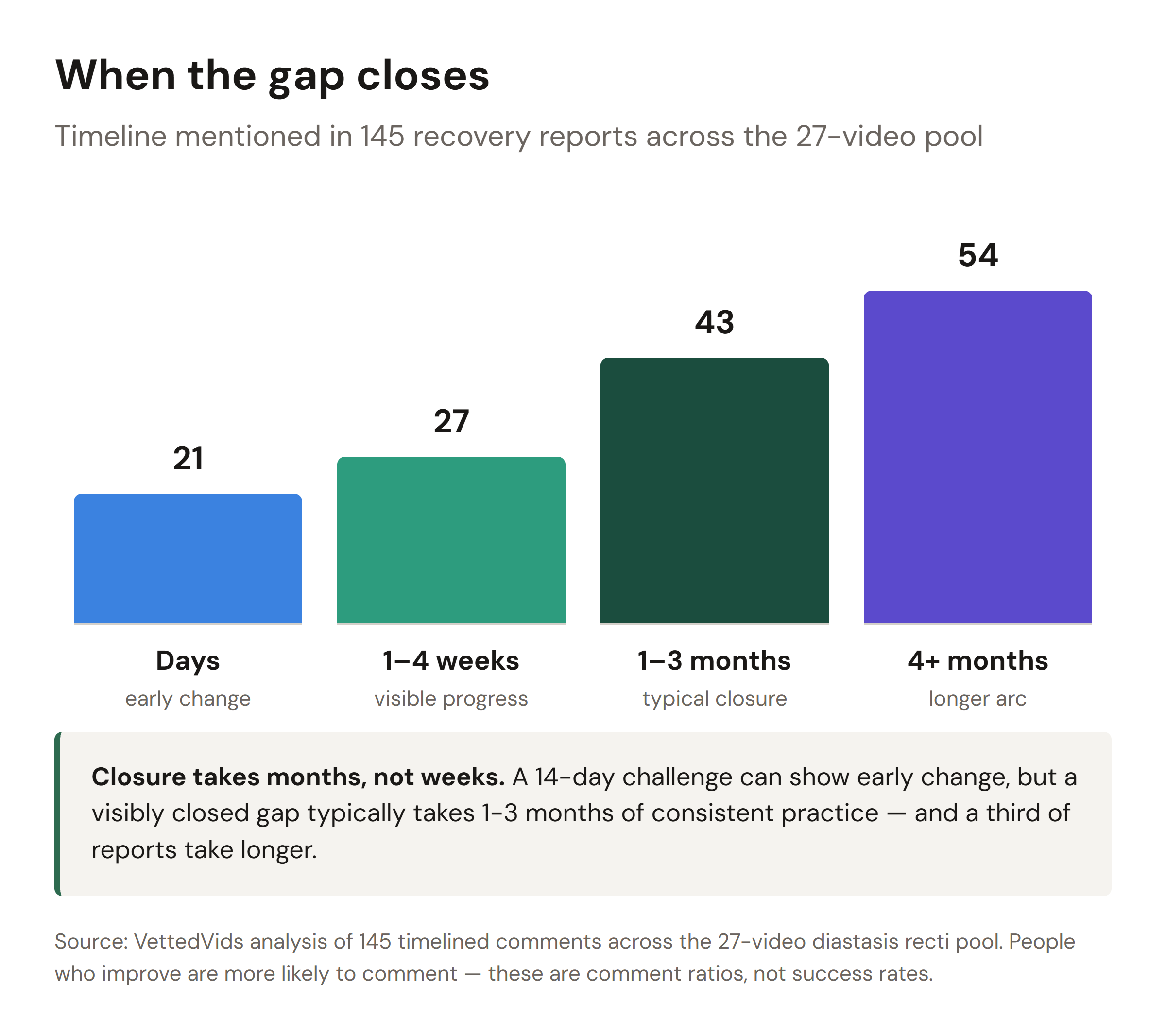
Diastasis commenters talk about timelines more than any other goal we've analysed — 145 of the 154 recovery reports include specific timeline language.
The honest median is one to three months of consistent practice. Roughly 30% of timelined reports fall in that window, and another 37% stretch past four months — sometimes years. Only 15% describe results within days, and those are almost always early-stage observations rather than closed gaps.
The stories retell well. One commenter, nearly thirteen years postpartum, had tried physical therapy, Pilates, and yoga. She'd been told she needed thirty minutes a day on her abs for over a year. She started a 12-minute video a few times a week, stuck with it for three months, and reported real change. Another, two weeks into a 28-day challenge, went from a four-finger gap to a two-finger gap — and wrote the comment early because she couldn't wait for day 28. A third, recovering from an emergency C-section, regained sensation in her lower abdomen after a week of the gentlest work in the routine.
A 14-day challenge can show early change. A closed gap usually takes months.
Where to look when you need more
The top five diastasis recti videos are four Personal Trainers and one Registered Dietitian. No Physical Therapists.
That's conspicuous, because pelvic floor physical therapists dominate the adjacent strengthen-pelvic-floor goal's top five. The same pelvic floor PTs publish on diastasis recti too — their videos sit in the wider 27-video pool. None of them landed in the top five for this goal.
The explanation is in format, not credential. The top-five videos here are all 10-to-15-minute follow-along routines with explicit beginner-and-advanced progression. The highest-credentialed single video in the pool — Tone and Tighten's "Exercises to Avoid," from a licensed Doctor of Physical Therapy — is a contraindications explainer, not a workout. The PT-led content in this pool skews toward shorter explainers and anatomy walk-throughs; the follow-along format, which the scoring favours, is more often produced by trainer-led creators here.
Read that as a signal about format fit, not credential quality. If you want a physical therapist explaining the anatomy before starting, Tone and Tighten and Michelle Kenway are both in the wider pool, and the strengthen-pelvic-floor goal page is where pelvic floor PTs consistently land at the top.
What to watch out for
The universal stop-signal across every top routine is doming during a basic movement. Several creators suggest filming yourself during a heel slide and looking for a line of tissue tenting up between the hips and the sternum — that's the self-check they consistently teach. When commenters describe this happening, the creators' advice is the same: pull back to the modified version, and if doming persists, stop.
Depth comes up repeatedly in commenter stories — a gap that feels deep, where the finger sinks rather than resting on firm tissue, is the signal commenters describe as prompting a visit to a pelvic floor physical therapist. None of the top five videos explain how to self-assess depth, and commenters with umbilical hernias, incontinence that started or worsened with exercise, pelvic pain, or low back pain that increases with core work consistently describe being referred to a clinician rather than continuing a YouTube routine alone.
Finger-width also shifts between lying flat and head-lifted. Several commenters describe a four-finger gap flat that closes to one finger as soon as they engage the core. Creators suggest measuring both ways before drawing conclusions.
Diastasis recti isn't only postpartum — men and women who have never been pregnant experience it too. If the typical framing doesn't match your situation, the postpartum-recovery umbrella and the pelvic floor goal page both offer different angles.
What's your experience with diastasis recti? Found something that worked — or something that didn't? Share your story in the comments below.
About VettedVids
VettedVids builds automated systems that analyse community-reported outcomes across YouTube to identify the content with the strongest evidence of real-world results. Every video is scored on verified success reports, creator credentials, content quality, and goal relevance. You can explore all topics at vettedvids.com.
Explore the videos
If you want to watch the videos behind this analysis, they're collected on the Rehab diastasis recti page. The data showed consistent overlap with adjacent conditions — strengthen-pelvic-floor is the natural next step for readers wanting a physical therapist's angle, postpartum-recovery is the umbrella goal, and manage-pelvic-prolapse covers a common co-occurrence.
As always, discuss any new exercise approach with a qualified healthcare professional, especially if you have a diagnosed condition.
VettedVids Insights publishes data analysis of publicly available YouTube content and community comments. This content is for informational purposes only and does not constitute medical, health, or professional advice. Always consult a qualified professional before making decisions based on this content.