What YouTube Comments Reveal About Back Pain Recovery
This article presents data analysis of publicly available YouTube comments. It is not medical advice. Always consult a qualified healthcare professional before making decisions about your health or starting any exercise programme.
Nine exercises keep showing up.
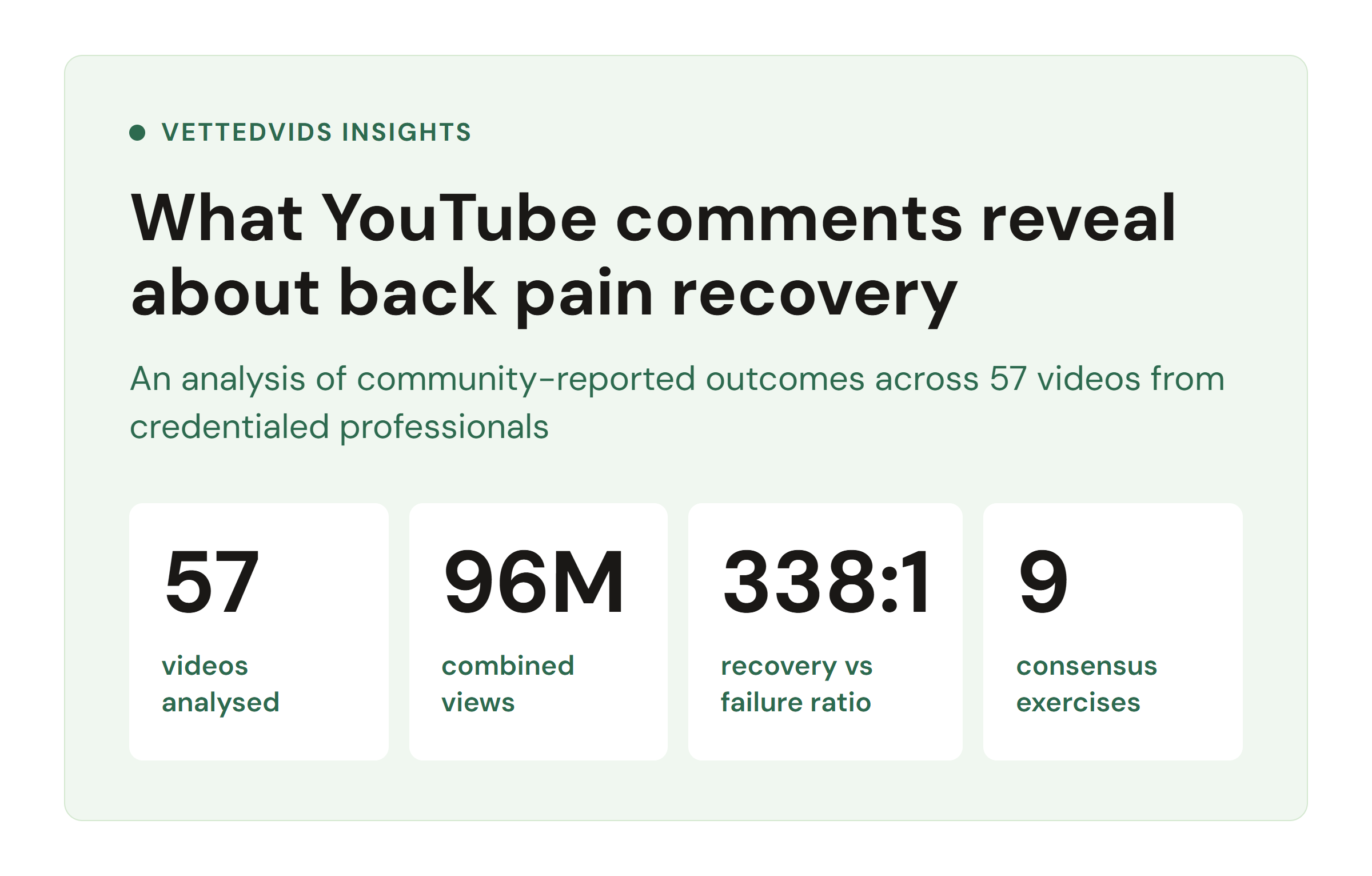
Across the highest-rated back pain videos on YouTube — 57 videos, 4,000+ community comments, most from licensed physical therapists, chiropractors, and physicians — the same nine movements appear independently, recommended by professionals who've never worked together.
But the single highest-scoring video in the entire dataset recommends none of them.
That's the finding that stood out. Here's what the data actually shows.
The numbers, honestly
Across the 10 highest-rated videos in this analysis — with a combined 96 million views — automated comment analysis identified 338 time-delayed recovery reports. These are comments posted days, weeks, or months after the video, describing specific improvements: reduced pain, restored mobility, return to activities people had given up on.
Against those 338 reports, there was 1 person who said the exercises didn't help.
Across the full 57-video dataset, the ratio is roughly 32 to 1.
An important caveat. These ratios don't mean 99.7% of people get better. YouTube comments have a strong survivorship bias — people who improve are far more likely to come back and comment than people who don't. What the ratios are useful for is comparing across videos. A video with a 338:1 ratio is consistently producing more recovery reports than one with a 10:1 ratio, and that relative signal is meaningful even if the absolute numbers aren't success rates.
With that honest framing, here's what the data reveals.
The 9-move consensus
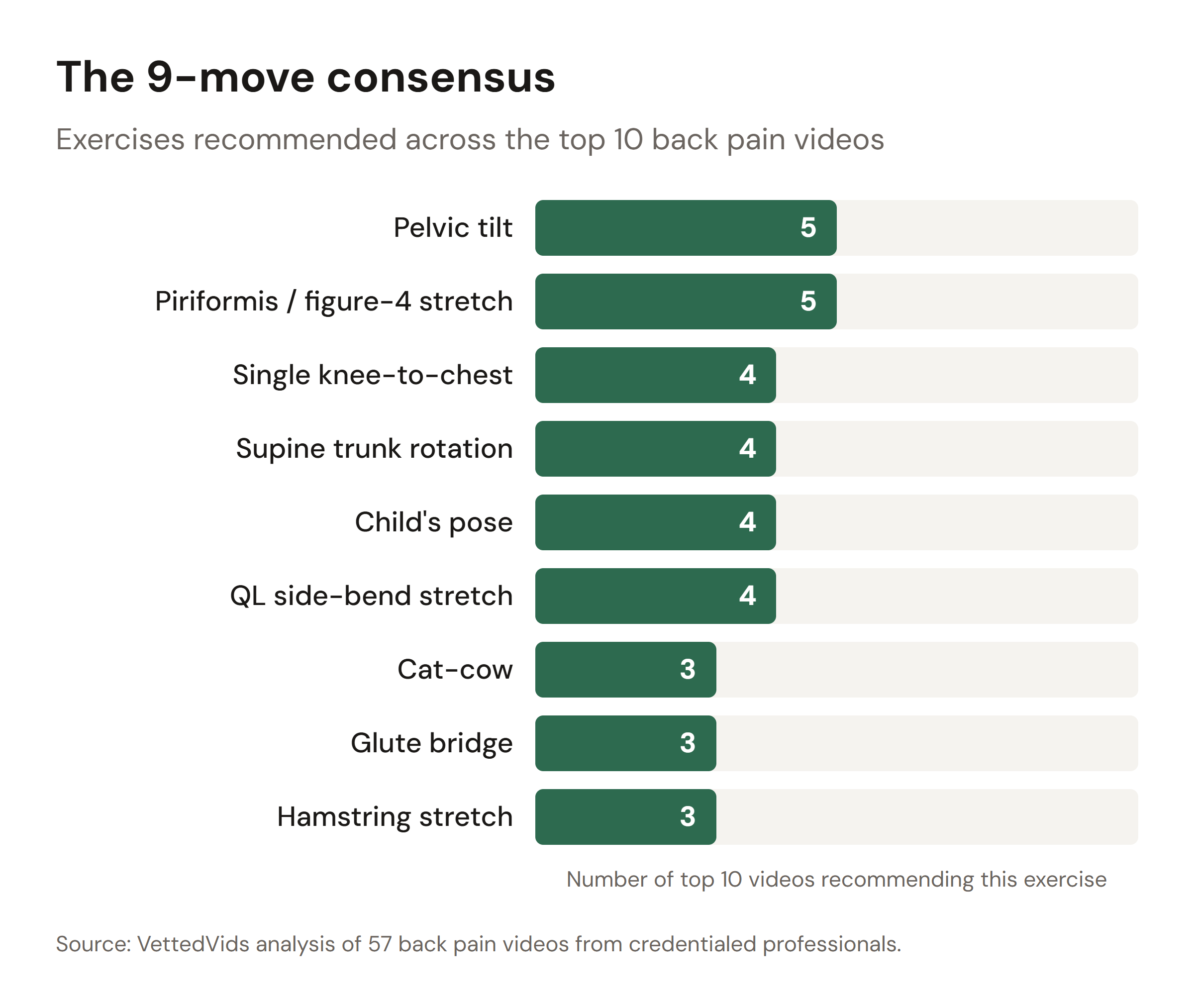
Nine exercises appeared across three or more of the top 10 videos:
Pelvic tilt and piriformis / figure-4 stretch — both in 5 of 10 videos. These are the most universally prescribed movements in the dataset. One commenter described trying every stretch imaginable until the pelvic tilt produced a minor pop and radiating warmth, followed by dramatically better sleep and walking.
Single knee-to-chest, supine trunk rotation, child's pose, and QL side-bend stretch — each in 4 of 10.
Cat-cow, glute bridge, and hamstring stretch — each in 3 of 10.
What's interesting isn't any individual exercise. It's that multiple professionals, creating content independently for different audiences, converge on essentially the same routine. Under 15 minutes. No equipment. And the recovery reports in all of their comment sections tell similar stories.
The video that breaks the pattern
Here's where it gets genuinely interesting.
The single highest-scoring video shares zero exercises with the other nine. Not one pelvic tilt. Not one knee-to-chest.
Instead, it reframes lower back pain as a glute medius problem — a small muscle on the side of the hip that, when dysfunctional, refers pain directly into the lower back. The approach is entirely different: trigger point pressure and hip strengthening rather than lumbar stretching.
The recovery reports for this video read differently from anything else in the dataset. People describing years of specialist visits, failed physiotherapy, expensive imaging — all for pain that turned out to originate from a muscle nobody had examined.
This doesn't invalidate the consensus exercises. But it suggests something important: a meaningful subset of what people experience as "back pain" is actually hip dysfunction, and no amount of lumbar stretching will reach it. The video itself provides detailed guidance on technique — it's worth watching in full rather than attempting to replicate the approach from a description.
When people get better
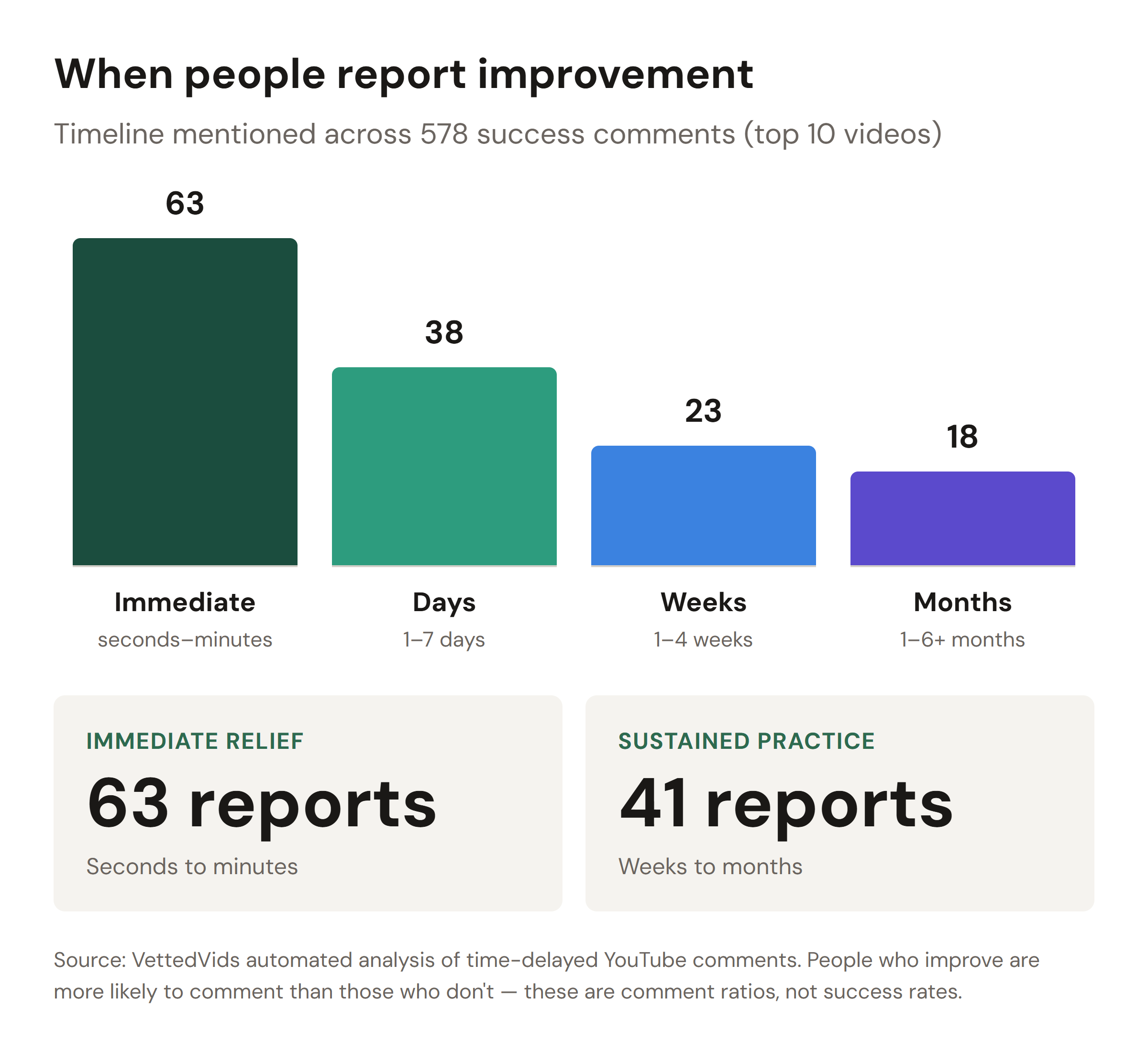
The dominant narrative in YouTube comments is instant relief. Over 60 of the top-10 recovery reports describe improvement within seconds or minutes.
But the recovery reports from chronic sufferers tell a different and more important story.
One commenter with autoimmune disorders and chronic pain described feeling no different after two days. No different after a week. After a month, they wondered whether they'd ever feel pain-free again. Their rheumatologist said: consistency over time is the key — give it six months. At just over two months of daily practice, things finally began to shift.
Another — 30 years of chronic lower back pain, herniated discs, two total hip replacements, and a new knee — reported standing up straight with no pain after committing to a routine twice daily.
A third — a 65-year-old woman, mostly sedentary, unable to sit, lie down, or stand without pain — started with the feeblest movements she could manage. Five days later she could stand without being pulled up.
About 15% of recovery reports explicitly mention daily repetition as part of what worked. It's a minority voice against the dominant "instant relief" narrative.
But it's the honest one.
Acute pain often responds to a single session. Chronic pain responds to a practice.
Structured routines vs quick fixes
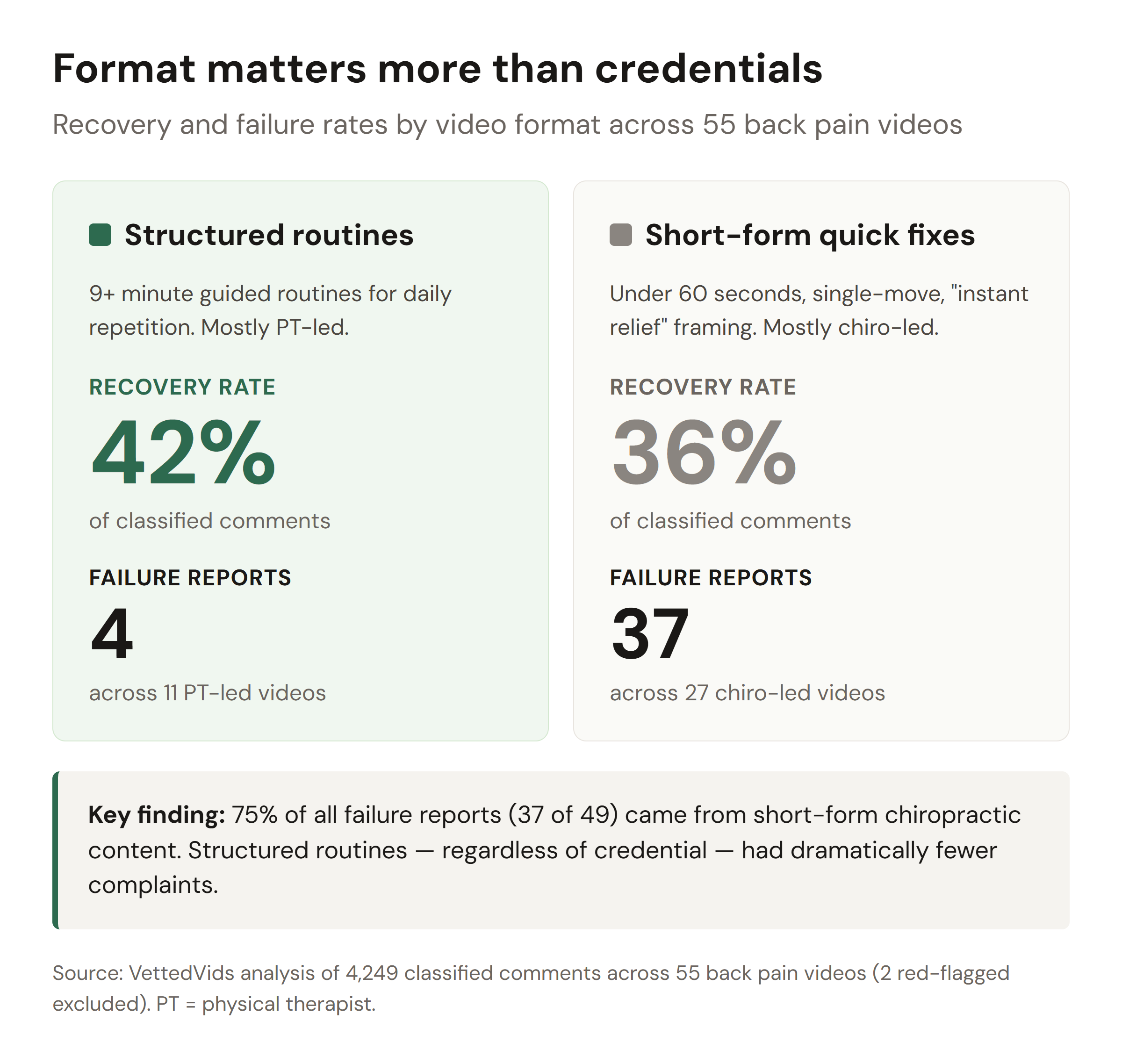
This was one of the clearest findings in the data. Physical therapist-led videos averaged a 42% recovery report rate per classified comment, compared to 36% for chiropractor-led content. PT videos also scored about 6 points higher on composite rating.
But the real story isn't about credentials. It's about format.
Of 49 failure reports across the full dataset, 37 came from chiropractor-led content — driven largely by short-form videos promising quick fixes without teaching a repeatable routine.
The structured, routine-based videos had dramatically fewer "this didn't work" reports, regardless of who made them. A 60-second video showing one stretch with "INSTANT RELIEF" in the title produces a different outcome pattern than a 9-minute guided routine designed for daily repetition.
When evaluating videos for yourself, the format may matter more than the credential on the thumbnail.
What to watch out for
Two of the top 10 videos explicitly flag something worth knowing: McKenzie press-ups — a cobra-like extension exercise — are effective for disc bulges but potentially harmful for spinal stenosis. This is the kind of nuance that matters when choosing which videos to follow, and it's a good example of why watching the full video (including the creator's cautions) is important rather than just replicating individual exercises.
Back pain isn't one condition. It's dozens of different conditions that show up in the same area. The consensus exercises are genuinely versatile — five of the top 10 back pain videos also rank highly for back spasm relief, and one ranks for sciatica relief. But if your pain includes nerve symptoms — numbness, tingling, or weakness in your legs — that's a different clinical picture that warrants professional assessment before trying anything from YouTube.
It's also worth noting that this analysis can't distinguish between types of back pain. Someone with a disc issue and someone with a muscle strain might both search the same terms and land on the same video. The consensus exercises are generally low-risk starting points, but they aren't a substitute for understanding your specific condition.
What's your experience with back pain recovery? Found something that worked — or something that didn't? Share your story in the comments below.
About VettedVids
VettedVids builds automated systems that analyse community-reported outcomes across YouTube to identify the content with the strongest evidence of real-world results. Every video is scored on verified success reports, creator credentials, content quality, and goal relevance. You can explore the back pain video rankings or browse all topics at vettedvids.com.
If you want to watch the videos behind this analysis, they're collected on our back pain page. The data also showed significant overlap between back pain, sciatica, and back spasms — five of the top 10 videos rank highly across multiple conditions. If your situation involves a specific diagnosis like a herniated disc or a desk posture component, those datasets tell their own stories. As always, discuss any new exercise approach with a qualified healthcare professional, especially if you have a diagnosed condition.