What YouTube Comments Reveal About Sciatica Recovery
This article presents data analysis of publicly available YouTube comments. It is not medical advice. Always consult a qualified healthcare professional before making decisions about your health or starting any exercise programme.
One exercise keeps coming up in sciatica videos that never appears in back pain routines.
It's called a nerve glide — a slow, controlled movement that mobilises the sciatic nerve through the tissues surrounding it. Three of the five highest-rated sciatica videos on YouTube teach it. None of the top back pain videos do.
That distinction matters. And the data behind it tells a more nuanced story than most people expect.
The numbers, honestly
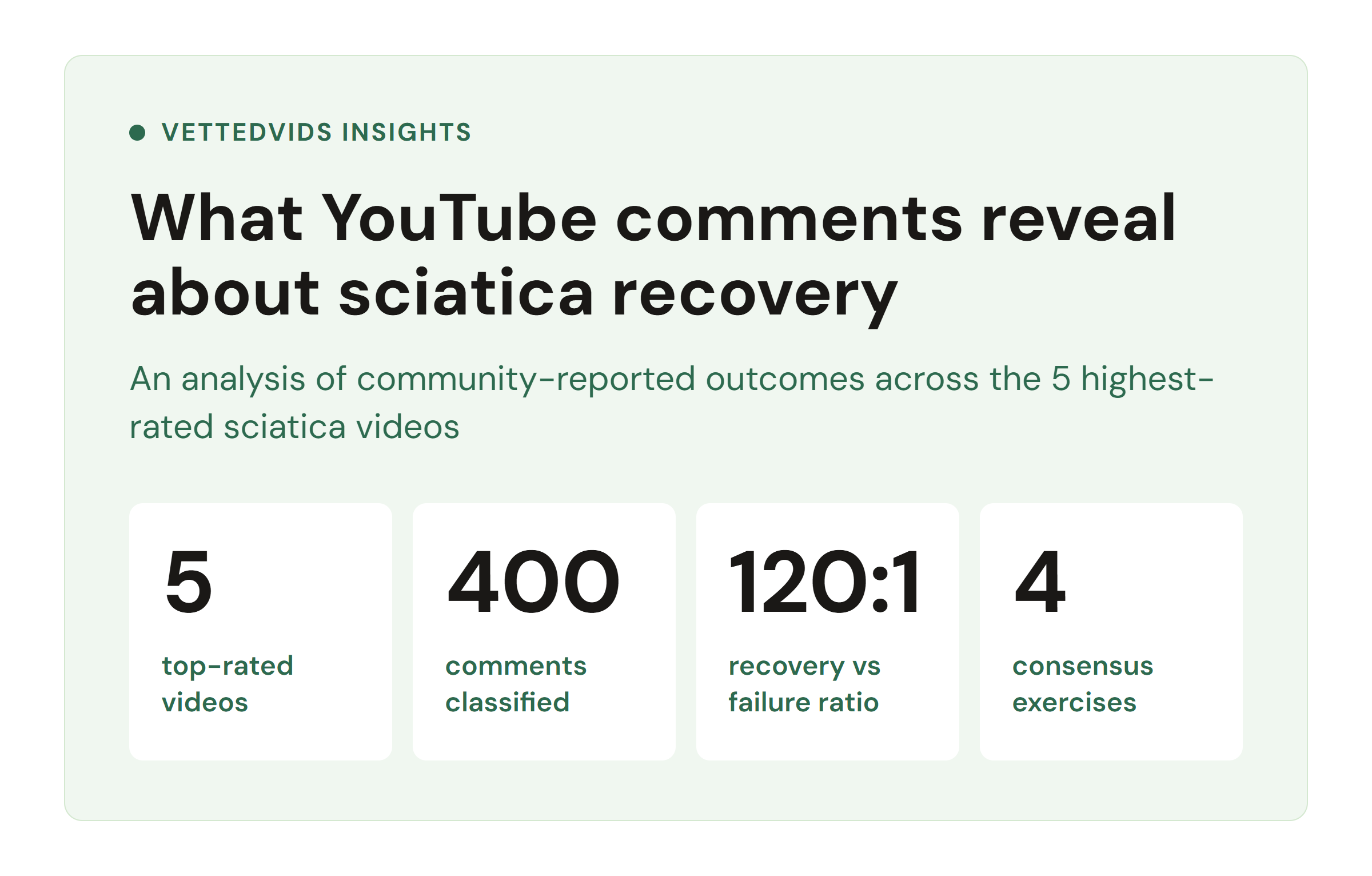
Across the five highest-rated sciatica videos — all from licensed physical therapists or experienced rehab coaches, with 400 classified comments between them — automated analysis identified 241 time-delayed recovery reports. These are people coming back days, weeks, or months later to describe specific improvements: reduced pain, restored mobility, the ability to walk or sleep again.
Against those 241 reports, there were 2 people who reported the exercises didn't fully help.
A ratio of 120 to 1.
The same caveat as always. These aren't success rates. YouTube comments carry a strong survivorship bias — people who improve are far more likely to return and comment. The ratios are useful for comparing across videos, not for predicting individual outcomes. A video with a 120:1 ratio is producing more recovery reports than one at 10:1, and that relative signal is meaningful.
With that framing, here's what the data reveals.
The 4-exercise consensus
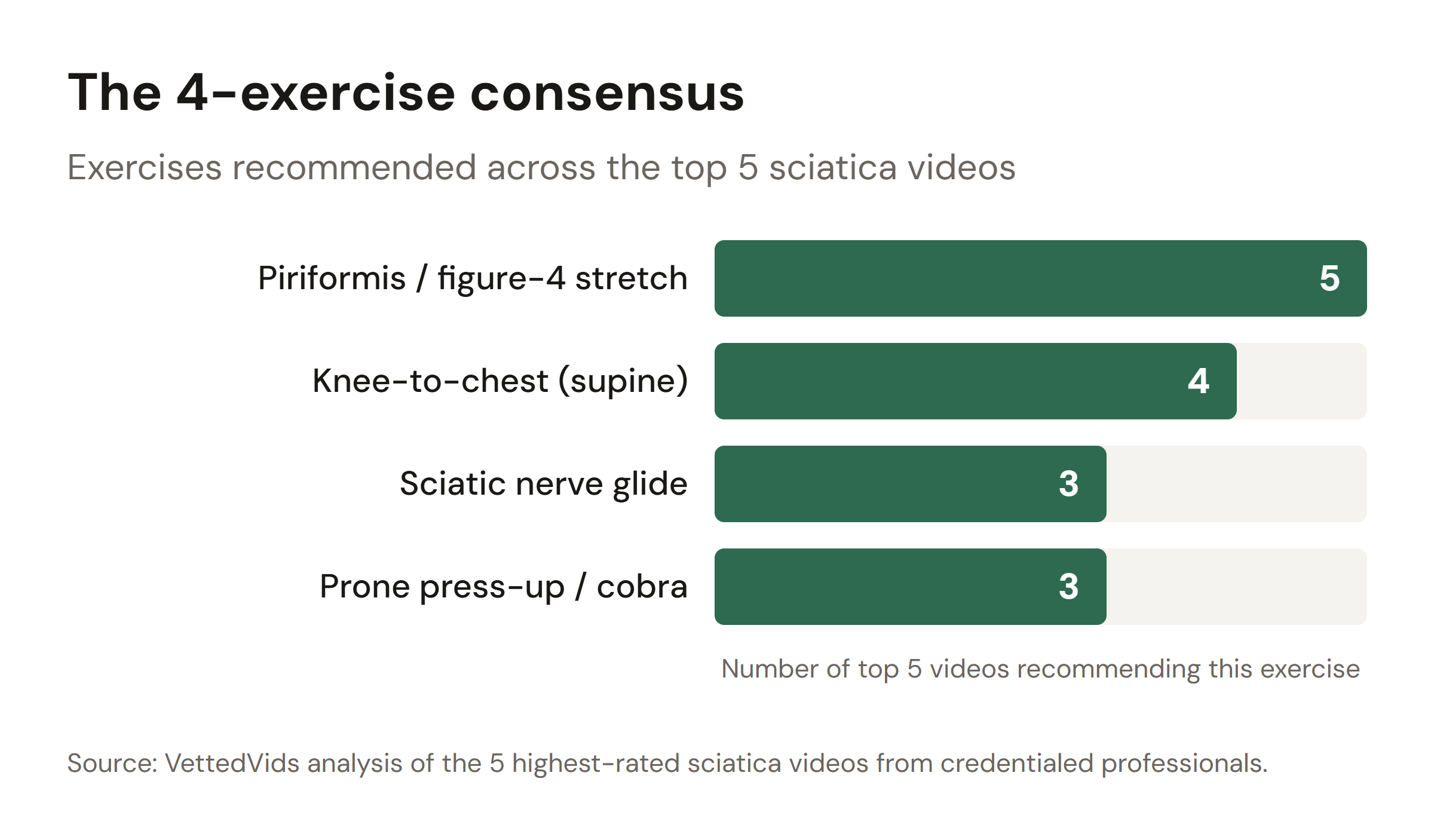
Four exercises appeared across three or more of the top five sciatica videos:
Piriformis / figure-4 stretch — in all five videos. This is the universal starting point for sciatica. Every creator teaches a variation: supine with crossed legs, pulling the knee toward the opposite shoulder, held for 20-30 seconds. The comment sections confirm it's usually the first thing people try — and for piriformis-driven sciatica, often the only thing they need.
Knee-to-chest — in four of five videos. A shared staple with back pain routines, used here for positional relief and gentle decompression.
Sciatic nerve glide — in three of five videos. This is the sciatica-specific signature move. Lying on your back, you bend one knee to your chest, then slowly extend the knee until you feel nerve tension, then return. The top-scoring video adds ankle pumps at the top of the movement — toes toward your face, then away — to increase the mobilisation effect.
Prone press-up / cobra extension — in three of five videos. This is the McKenzie protocol, specifically for people whose sciatica originates from a disc bulge or herniation. Two of the five creators explicitly caution that press-ups are for disc issues only and can worsen stenosis — an important distinction.
The nerve glide: sciatica's defining technique
The piriformis stretch appears in both back pain and sciatica routines. The knee-to-chest appears in both. The pelvic tilt appears in both.
The nerve glide appears only in sciatica content.
This makes it the single most differentiating technique between the two conditions. And the comment sections confirm its importance. In the top-scoring video — Tone and Tighten's "The ONE Exercise You MUST Do For Sciatica Pain Relief" — the nerve glide with ankle pumps is the exercise the creator says 90% of his patients receive. The comments for that video are striking: a 26-year-old who couldn't walk that morning reported significant improvement after one session. Someone with a bulge at L5/S1 who couldn't walk the day before went to a football game the next day with minor discomfort.
The nerve glide works differently from stretching. Rather than lengthening a muscle, it's designed to restore the nerve's ability to slide freely through surrounding tissue. When the sciatic nerve gets compressed or adhered — whether from a disc bulge, piriformis tightness, or inflammation — the nerve glide gently mobilises it. The sensation is distinctive: a pulling or tension down the leg that eases with repetition.
When people get better
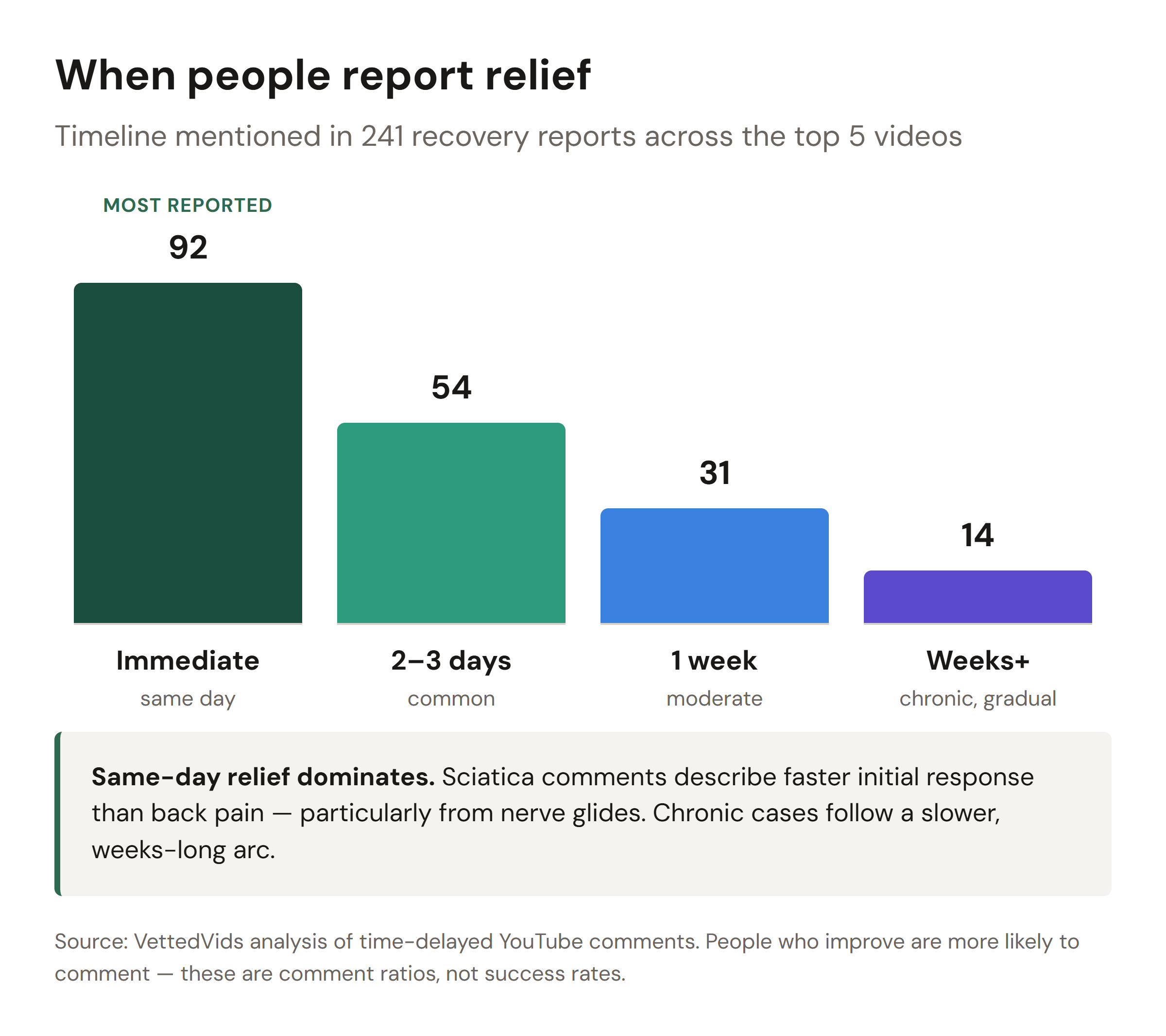
The most striking pattern in sciatica comments is how fast people report relief.
The dominant phrasing is "first stretch," "immediate," "pain free by morning." This is different from back pain, where chronic sufferers consistently emphasise weeks of daily practice. Sciatica relief — particularly from nerve glides — appears to produce faster initial response.
A new mother described being unable to stand, with severe pain running down her leg. The exercises relieved her enough to walk again. Someone who had just checked into a hotel and was about to go to the emergency room did the exercises instead and cancelled the ER trip. A woman who'd had sciatica for nine years since her first child — paying for stretch classes the entire time — woke up after one session and stepped out of bed pain-free.
One commenter put it starkly: a $6,000 emergency room visit had produced pain medication with side effects, while a 19-minute free exercise video produced more relief. This isn't an argument against emergency care — it's a reflection of how frustrated people become when expensive medical visits don't address their specific problem.
But not everyone responds immediately. People with desiccated discs, long-standing chronic conditions, or post-surgical complications describe a different timeline — initial sessions that make things temporarily worse before gradual improvement over days or weeks. One commenter explicitly described this pattern: the first few sessions increased their leg pain, but after persisting, the pain gradually reduced. This initial-worsening phase is clinically recognised with nerve mobilisation work and worth knowing about.
Where sciatica and back pain converge

Three of the five top-rated sciatica videos also appear in our back pain scored results — with nearly identical scores across both goals (within 1-2 points). The two conditions share a large exercise foundation: piriformis stretch, knee-to-chest, pelvic tilt, trunk rotation.
But sciatica adds a nerve-specific layer on top: nerve glides, McKenzie press-ups for disc involvement, and lateral shift corrections. These techniques don't appear in back pain routines because they target the nerve itself rather than the surrounding muscles.
The comment sections reflect this overlap. Across the sciatica videos, 25 commenters explicitly mention back pain. In our back pain analysis, 34 commenters mention sciatica. The two populations overlap heavily — people experiencing either condition frequently experience both and search for both.
The practical implication: if you're dealing with sciatica, a general back pain routine covers the foundational exercises. But you'll likely need the nerve glide and possibly the McKenzie protocol on top of that foundation, depending on whether your sciatica involves a disc component. The top-scoring video in this analysis explicitly branches its recommendations by diagnosis: nerve glides for all sciatica, press-ups for disc bulges, posterior pelvic tilts for stenosis. That kind of diagnostic branching is what separates the highest-rated content from generic stretch compilations.
What to watch out for
Eighteen commenters across the five videos mention herniated or bulging discs, making it the most commonly reported underlying condition. If you know you have a disc issue, the McKenzie-based exercises (press-ups, lateral shifts) are specifically designed for that presentation — but they can aggravate stenosis. Two of the five creators explicitly flag this distinction.
If your sciatica includes numbness, weakness, or loss of bladder or bowel function, that's a medical emergency — not a YouTube exercise scenario. Several commenters mention these symptoms casually alongside their recovery stories, which is worth noting: the fact that someone else had similar symptoms and improved with exercises doesn't mean professional assessment isn't warranted in your case.
Four commenters mention pregnancy or postpartum sciatica. This is a distinct presentation with different exercise considerations, and we cover it separately on our pregnancy back pain page.
What's your experience with sciatica? Found something that helped — or something that made it worse? Share your story in the comments below.
About VettedVids
VettedVids builds automated systems that analyse community-reported outcomes across YouTube to identify the content with the strongest evidence of real-world results. Every video is scored on verified success reports, creator credentials, content quality, and goal relevance. You can explore all topics at vettedvids.com.
Explore the videos
If you want to watch the videos behind this analysis, they're collected on our sciatica page. The data also showed significant overlap with back pain — three of the top five sciatica videos rank highly for both conditions. If your situation involves a confirmed herniated disc, that goal page has its own scored results focused on disc-specific approaches.
As always, discuss any new exercise approach with a qualified healthcare professional, especially if you have a diagnosed condition.
VettedVids Insights publishes data analysis of publicly available YouTube content and community comments. This content is for informational purposes only and does not constitute medical, health, or professional advice. Always consult a qualified professional before making decisions based on this content.