The Physical Therapists Whose YouTube Videos Consistently Get Results
This article presents data analysis of publicly available YouTube content and community comments. It is not medical advice. Always consult a qualified healthcare professional before making decisions about your health or starting any exercise programme.
When it comes to pain, injury, and movement rehab, physical therapists make the best videos on YouTube.
That's not an opinion. Across the movement and rehab goals VettedVids has scored — back pain, sciatica, carpal tunnel, knee arthritis, and dozens of similar conditions — physical therapists produce the highest-rated content of any credential group. The gap over chiropractors, the next-closest credential, is consistent and measurable.
This finding is domain-specific. PTs aren't a meaningful presence in nutrition, mental health, dermatology, or other non-movement health content. But within movement and rehab — where the treatment is exercise and the creators are teaching exercise — they are the credential group that consistently delivers.
The gap isn't enormous. But it's consistent. And the data behind it is worth understanding.
The numbers
We scored every video on four dimensions: community-reported outcomes (do commenters report it actually helped?), content quality (is the instruction clear and thorough?), creator credentials (what's their professional background?), and goal relevance (does the video address what the viewer is looking for?).
When we grouped creators by credential type — restricting to those appearing across three or more goals to filter out one-hit wonders — the ranking was clear.
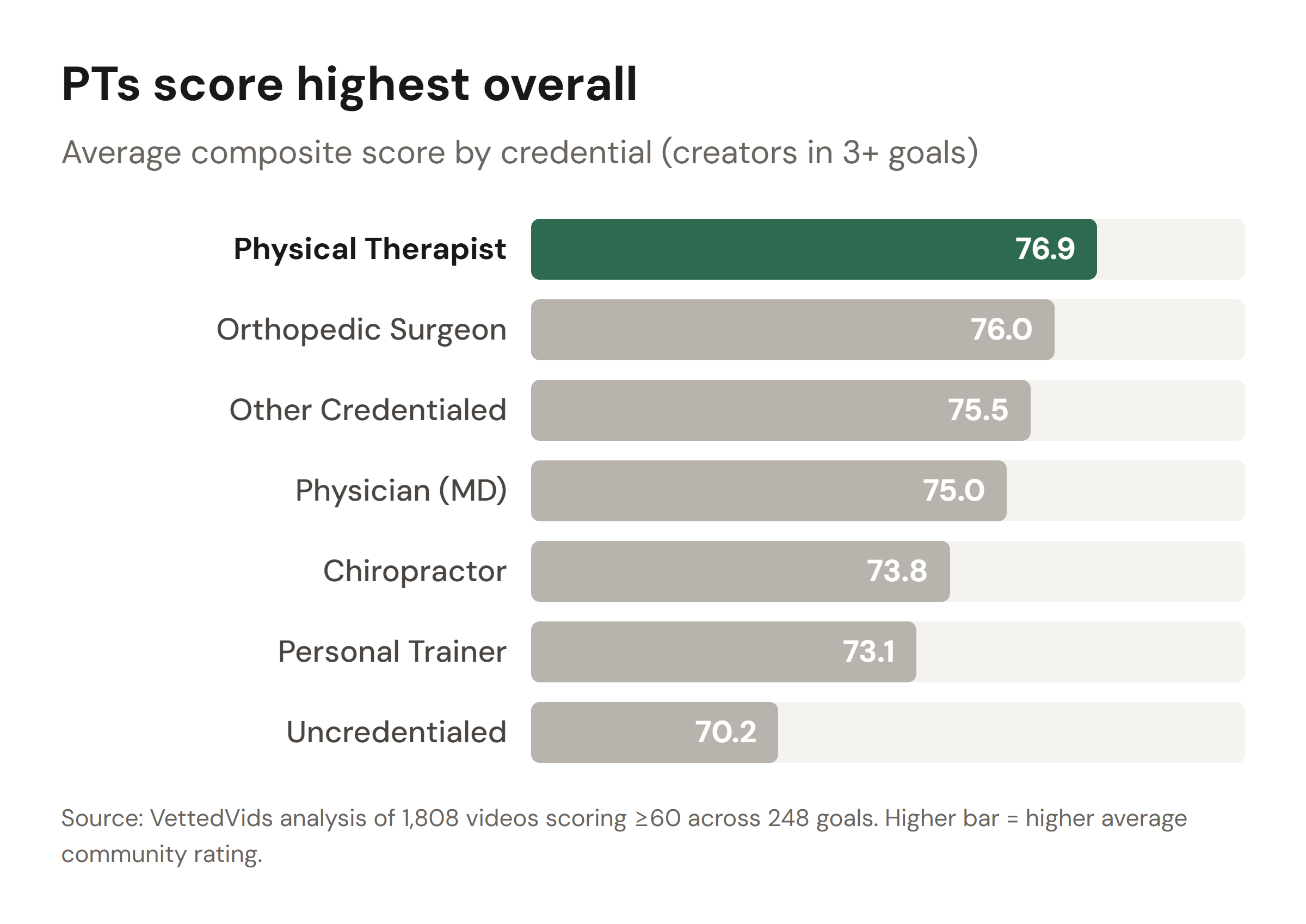
Physical therapists averaged 76.9 across 261 videos. Chiropractors averaged 73.8 across 268 videos — nearly identical volume, but a consistent 3.1-point quality gap.
That gap isn't about credentials per se. It's about what PTs tend to do differently: structured routines designed for daily repetition, clear progression guidance, and time spent explaining why an exercise works rather than just demonstrating it. This finding echoes what we saw in our back pain analysis — routine-based videos consistently outperform quick-fix content regardless of who makes them. PTs just happen to make routine-based content more often.
The four you've probably already seen
If you've searched YouTube for any pain or rehab topic, you've likely encountered at least one of these channels. They're the most widely represented PTs in our dataset.
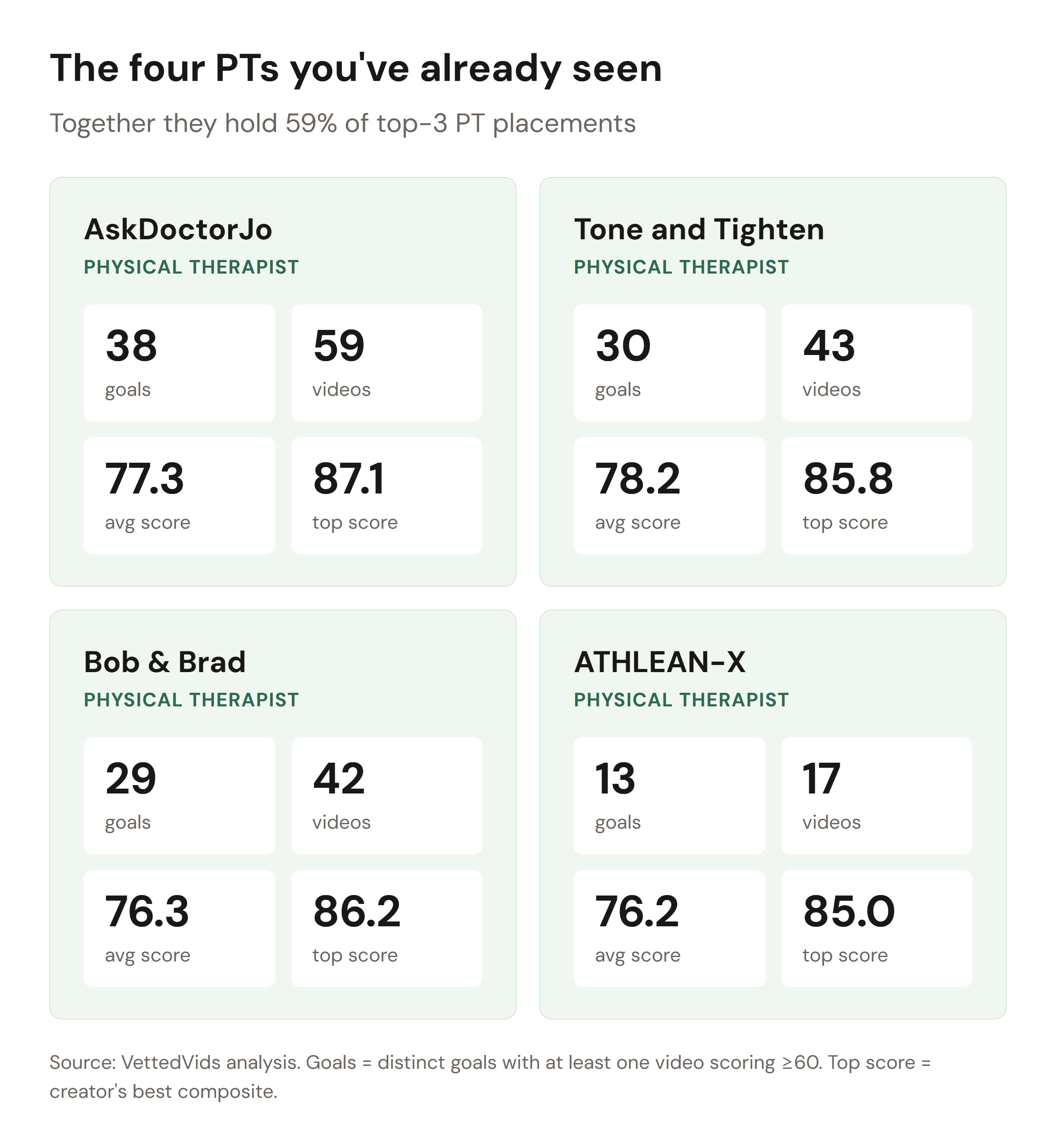
AskDoctorJo — 38 goals, 59 videos scored. The broadest PT on the platform. Her videos rank in our top results for everything from pregnancy back pain (87.1) to ACL rehab to tinnitus relief. What stands out in her comment sections: people consistently describe her as the creator who finally explained things in a way they could follow at home.
Tone and Tighten — 30 goals, 43 videos, 78.2 average. The highest average score among high-volume PTs. His number-one ranked videos span an unusually wide range: golfer's elbow (85.8), carpal tunnel (85.2), cubital tunnel (85.0), sciatica (83.5). The common thread is structured routines with specific rep counts and progression timelines.
Bob & Brad — 29 goals, 42 videos. The duo owns the hand, wrist, and elbow niche: their de Quervain's video (86.2) and wrist tendonitis video (84.5) are among the highest-scoring PT content in the entire dataset. Their style is informal and accessible — which the comment sections suggest makes people more likely to actually do the exercises.
ATHLEAN-X — 13 goals, 17 videos. Jeff Cavaliere brings a dual credential (DPT and CSCS) and a different audience: his videos reach into strength training and posture goals that traditional PT channels don't cover. His back pain video (84.5) and herniated disc video (85.0) rank first in their respective categories.
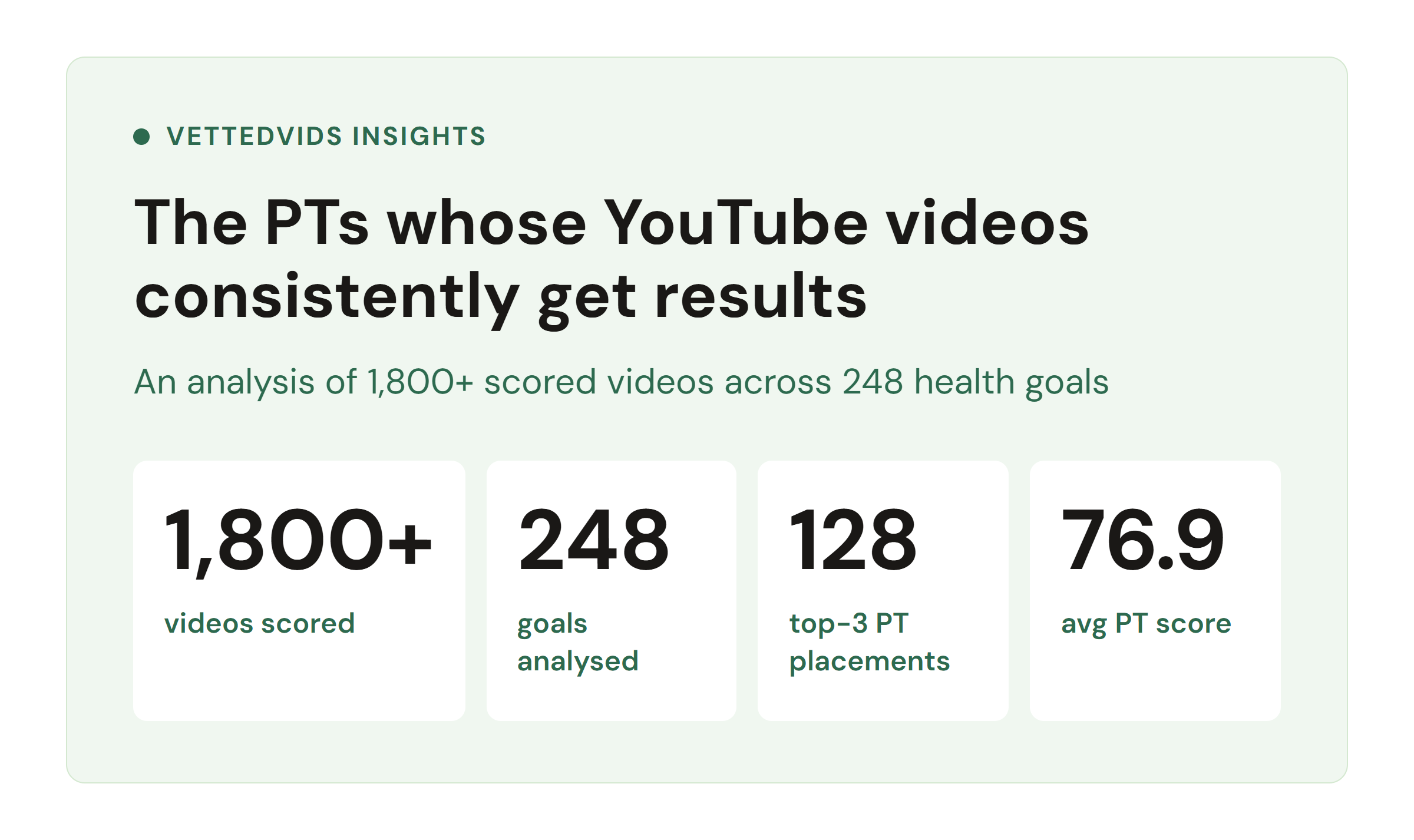
Together, these four channels account for 76 of the 128 top-three PT video placements across all goals. They're the backbone of evidence-based movement content on YouTube.
The hidden gems that score even higher
Here's what surprised us. The highest average scores don't belong to the big four. They belong to smaller, more specialist channels that most people haven't found.
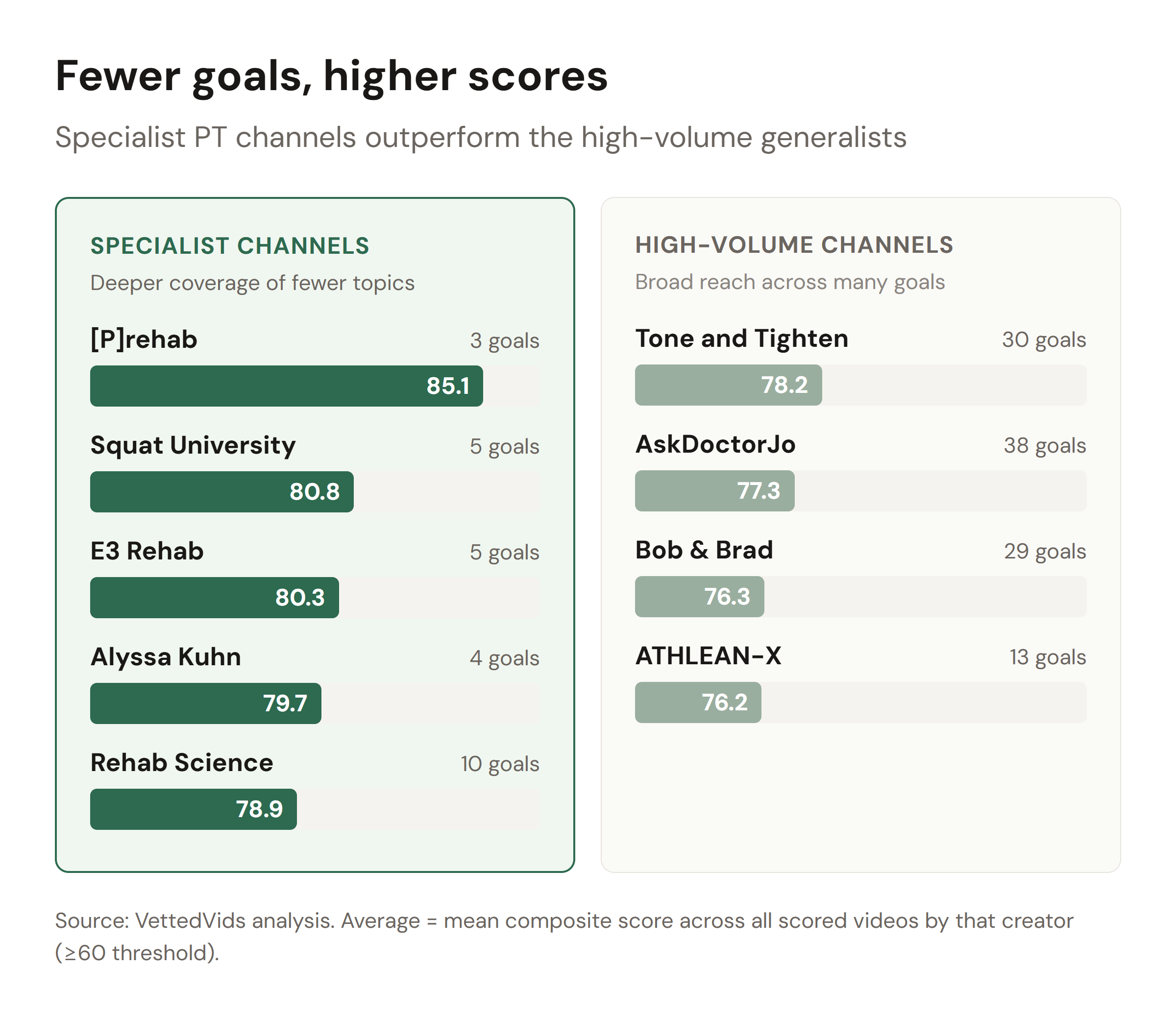
[P]rehab averages 85.1 across three goals — the highest of any PT creator. Squat University averages 80.8 across five goals. E3 Rehab averages 80.3 across five goals. Alyssa Kuhn (Arthritis Adventure) averages 79.7 across four goals, with a tight focus on arthritis-specific movement.
These channels have smaller audiences but produce exceptionally focused content. Their comment sections tend to be more detailed — people describing specific conditions and reporting specific outcomes rather than general praise.
The pattern is consistent across our data: specialist creators who go deep on fewer topics tend to score higher than generalists who cover everything. This doesn't make the big four worse — their breadth is genuinely valuable, and their scores are strong. But if you're dealing with a specific condition, the specialist channel for that condition may be worth seeking out.
Where PTs dominate (and where they don't)
PTs own certain categories almost entirely. Cubital tunnel syndrome, de Quervain's tenosynovitis, IT band syndrome, Morton's neuroma, SI joint pain, patellar tendonitis, calf strain rehab — these are conditions where PT content dominates the top results and other credential groups barely appear.
This makes intuitive sense. These are movement-based conditions where the treatment is exercise, and PTs are the professionals trained specifically in exercise prescription. An MD might diagnose the condition, but the PT is the one teaching you what to do about it.
In broader categories like back pain and sciatica, PTs share the top results with chiropractors. And in non-musculoskeletal domains — dermatology, nutrition, mental health — PTs aren't present at all. The credential advantage is domain-specific.
What this means for you
If you're searching YouTube for help with a physical pain or injury, starting with PT-created content is a reasonable default. The data supports it across a large sample.
But credentials are a starting filter, not an ending one. The most important factors in our scoring are community-reported outcomes and content quality — and those vary more within credential groups than between them. A well-structured chiropractor video with strong recovery reports will outscore a mediocre PT video every time.
The real question isn't "is this person a PT?" It's "did the people who tried this actually get better?"
That's what we measure.
Have a favourite PT channel we should know about? Or a creator whose videos helped you recover? Share in the comments below.
About VettedVids
VettedVids builds automated systems that analyse community-reported outcomes across YouTube to identify the content with the strongest evidence of real-world results. Every video is scored on verified success reports, creator credentials, content quality, and goal relevance. You can explore all topics at vettedvids.com.
Explore the creators
Many of the PT channels mentioned in this analysis have top-rated videos across multiple goals. You can see their work in context on our back pain, sciatica, plantar fasciitis, carpal tunnel, and herniated disc pages, among others.
As always, discuss any new exercise approach with a qualified healthcare professional, especially if you have a diagnosed condition.
VettedVids Insights publishes data analysis of publicly available YouTube content and community comments. This content is for informational purposes only and does not constitute medical, health, or professional advice. Always consult a qualified professional before making decisions based on this content.